Full ITER ensemble passes five-second convergence
The complete ITER ensemble now passes the declared numerical convergence checks. all 33 original cases reach five seconds at all three maximum-step settings: 99 of 99 valid trajectories and 264 of 264 passing endpoint comparisonsC-305. This resolves the tested baseline’s convergence blocker for the current model and settings. The primer explains the coupled simulation and its guarded surrogates.
We reran the original design using the strict physical-residual solve and continuous transport closure. Every original case and member remains in the design. The transition widths and radial coefficient smoothing stay fixed across this comparison. The completed sentinels were re-audited alongside the remaining fresh trajectories.
Each case has three adaptive maximum-step settings. Both adjacent comparisons must pass for fusion power, stored thermal energy, and axis electron and ion temperature. A finer-cap result supplies each relative-error denominator. the largest changes are 0.219% for coarse-to-middle and 0.0423% for middle-to-fine, both below the 1% acceptance limitC-306. No case is discarded to obtain the pass.
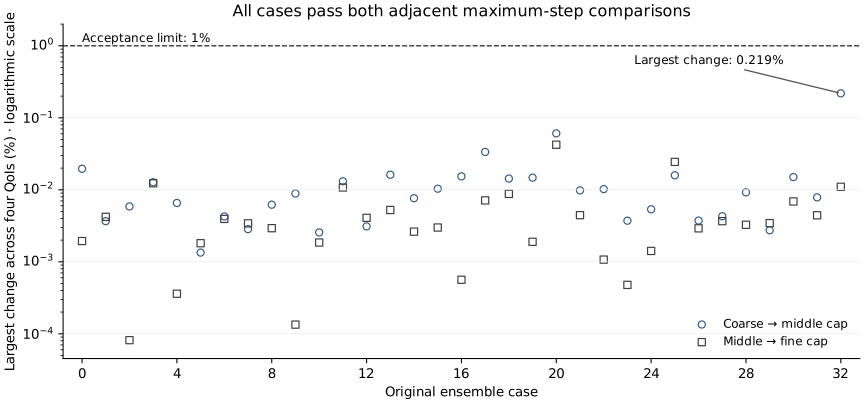
Figure provenance
- Tier: A; measured public ITER numerical scenario.
- Producer:
blog.figures.make_m5_convergence; source2563ca4(dirty at generation: True). - Configuration SHA-256:
e31a1147b1db7c07480ccc9231f77c9035097dd62236414a9e3a74897475ef92. - Bound raw-audit SHA-256:
50b76a04bd897bbd7154a1a299623f7c6b499bfada9bf2827dba959a944c99b6. - Python 3.11.7; JAX 0.10.2; CPU saved-array audit.
- Recorded: 2026-11-01. No new simulation was run to plot this figure.
The final audit reconstructs the equations from raw cell storage, transport and source terms, checks every accepted step, and binds all reporting endpoints to raw profiles and quantities. maximum accepted physical-channel L1 is 1.76 × 10⁻⁹ against a 10−8 gate, and native mean L1 is 1.01 × 10⁻¹⁴ against 10−10; no crash occursC-307. It also retains the failed proposals rather than hiding them: 372,141 accepted proposals and 2,659 rejected proposals are retained in 23,100 raw chunks; rejected-step rollback and retry schedules pass reconstructionC-308.
The audit is separate from the integration’s acceptance decision. Source and input hashes, scheduler completion and both adjacent comparisons are required for the combined pass. Successful process exit alone never supplies convergence.
This is a substantial change from the earlier unresolved numerical baseline. It is also a precisely scoped result: the successful continuous closure differs from the earlier hard-switch closure. These adaptive-cap comparisons establish neither a fixed-step convergence order nor experimental physical validity. Smoothing-width robustness and a direct particle-flux formulation remain separate studies. The historical uncertainty results have not been silently recomputed.
M5’s numerical baseline passes; physicist sign-off remains pending. The next uncertainty study must explicitly use this baseline and its complete declared design.
Technical details → full ensemble protocol. Milestone → M5.
Technical details → Physical-residual solves and ensemble convergence › full ensemble convergence · Uncertainty propagation and validation › continuous baseline
Decisions → OQ-49