ITER L-mode benchmark against RAPTOR, from the TORAX paper
M1 asks that the benchmark match published profiles within a tolerance set by a physicist (see the Primer). The ITER hybrid scenarios we have used so far have no published profiles from a second code, only TORAX’s own output, which our loop reproduces to round-off. The TORAX paper (Citrin et al., arXiv:2406.06718) publishes one quantitative comparison with an independent code, RAPTOR: an ITER L-mode plasma with constant current, constant heating and constant transport coefficients, run until the profiles are steady. The owner chose this case as the M1 physics benchmark (OQ-12).
Method
The paper gives the full TORAX configuration (its Table II), written for an early TORAX version. We translated it to TORAX 1.4.3 parameter names. One setting needed care: the paper fixes the neon impurity’s charge at 10, while TORAX 1.4 computes it from the electron temperature. Leaving the computed charge in place changes the ion density: 0.35% with the computed charge, 0.009% with Z = 10C-056.
The comparison data come from the paper’s Fig. 6. The figure is vector graphics, so the plotted points of both curves, RAPTOR and the paper’s own TORAX run, are stored in the PDF. We read them out and mapped them to data units with each panel’s tick marks. To check the read-out, we recomputed the paper’s error measure (normalised root-mean-square deviation, NRMSD) between its two curves: all five printed values reproduced (1.102, 0.712, 0.026, 0.414, 0.701% vs 1.1, 0.71, 0.03, 0.41, 0.70%)C-048.
The run goes through the Tokamak Toolkit’s fixed-step loop over TORAX’s time step. It matches TORAX’s own driver to better than 10-13C-049, so the comparison below tests the physics, not the wrapper.
Results
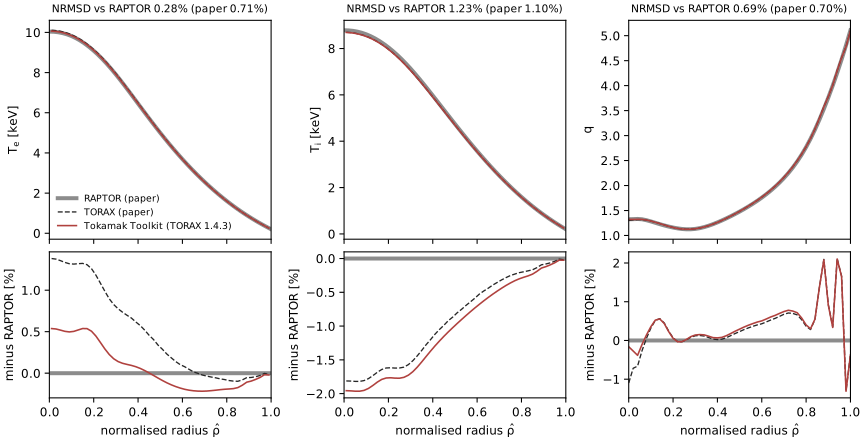
Against RAPTOR, NRMSD at the end of the run (the paper’s TORAX in brackets): T_i 1.23% (1.1%), T_e 0.28% (0.71%), n_e 0.03% (0.03%), psi 0.49% (0.41%), q 0.69% (0.70%)C-050. Against the paper’s TORAX run: T_i 0.13%, T_e 0.50%, n_e 0.01%, psi 0.08%, q 0.16%; Ohmic power density 3.6%C-051. That second line measures how much TORAX has changed between the paper’s version and 1.4.3, plus any translation error. It is largest for the electron temperature and the Ohmic heating, which depend on the plasma’s electrical conductivity.
Halving the time step three times changes these end-of-run numbers by at most 0.006 percentage pointsC-052, so the published step is fine for the end state. The transient differs more; that is on the technical page.
The other M1 criteria hold on this case as well. Energy and particle balance close on every step: energy 1.1 × 10⁻⁷, particles 3 × 10-13C-054. The gradient of stored energy through three steps matches finite differences to 6 × 10⁻⁹C-055. Forward-mode derivatives through TORAX’s Newton solver came out as NaN at first (ceiling K-009, since fixed in entry 14).
Run: tkit benchmark-raptor --dt 0.05 at commit d689def (clean tree), config hash c9f9626e, TORAX 1.4.3, JAX 0.10.2, Python 3.11.7, float64, tier A, 2026-10-01. Reference curves: arXiv:2406.06718v4 Fig. 6 (CC BY 4.0), read from the PDF’s vector paths. Figure: blog/figures/make_raptor_lmode.py; data in raptor_lmode.csv.
Where this stands: M1 in progress. All four acceptance criteria now have results on a published benchmark. The tolerance against RAPTOR is the physicist reviewer’s (OQ-5); the review is the M1 gate.
Technical details → Backends: the RAPTOR L-mode benchmark
Technical details → Backends › raptor benchmark
Decisions → OQ-12 · OQ-5